
Is MallWorld Real?

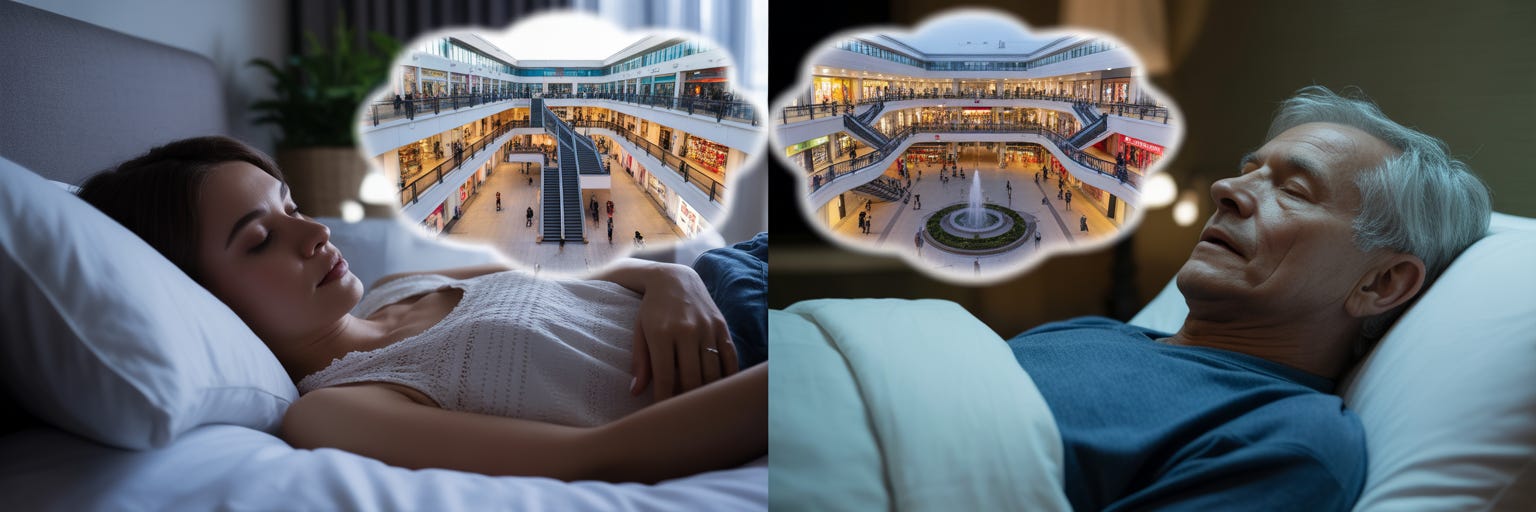
Imagine going to sleep and waking up in an infinite, maze-like shopping mall.
The lighting is slightly off, the escalators defy physics, and the corridors lead to abandoned food courts, dark basement levels, or endless, dirty bathrooms.
You’ve never been to this place in waking life, but in the dream, you know exactly how to navigate it.
This is Mallworld—a bizarrely consistent, recurring dream environment experienced by thousands of unconnected people across the globe.
It is the ultimate “liminal space,” sitting in an uncanny zone between the familiar and the surreal.
Here is the story, the timeline, and the evidence behind the internet’s most fascinating shared dream.
--------------------------------------------------------------------------------
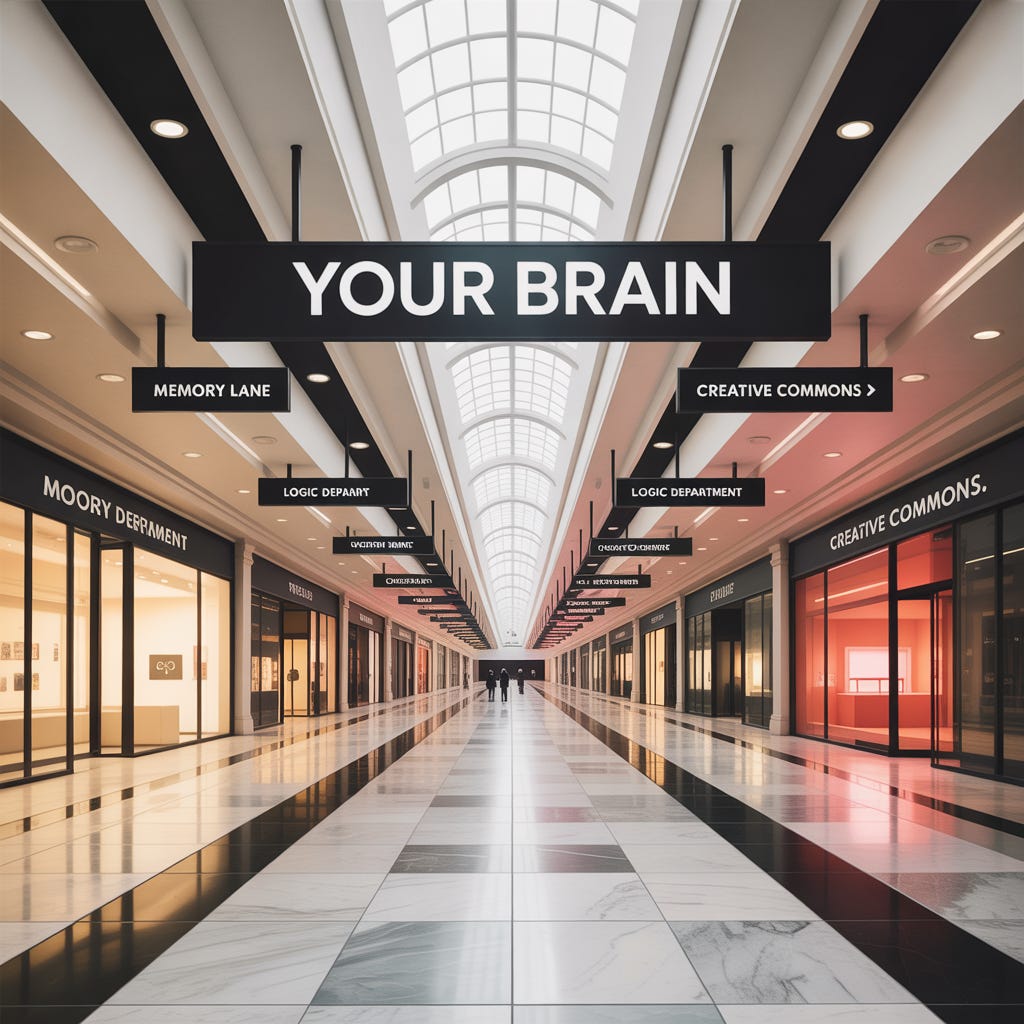
📅 The Timeline of Mallworld
While the aesthetic of eerie, empty spaces has existed for years, the specific viral phenomenon of Mallworld has a distinct digital paper trail:
2016: The Spark. The term was officially coined by an anonymous Canadian user on an obscure paranormal forum called Godlike Productions (GLP), asking: “Anyone Frequent ‘Mall World’ In Their Dreams?” The thread exploded with over 1,500 replies.
2019: The 4chan Spread. The discussion migrated to 4chan’s paranormal board, where users began comparing notes on connecting dream-zones like “University World” and “Library World”.
2021: The Reddit Hub. The dedicated subreddit
r/TheMallWorldwas created, giving dreamers a centralized place to share maps, theories, and experiences.October 2025: Mainstream Explosion. A 32-year-old artist named Jessica Tilton posted a hand-drawn map of her recurring Mallworld dream on TikTok. The video garnered over two million views, prompting mainstream coverage from The New York Times and Forbes.
--------------------------------------------------------------------------------
📂 Present Evidence: What Do We Actually Know?
The Anecdotal Data There is a massive volume of qualitative, anecdotal data. The r/TheMallWorld community acts as a live archive where thousands of people document identical architectural anomalies. A survey of nearly 300 dreamers confirmed that the vast majority experience it as a persistent, recurring location, with the “infinite toilets,” the dark lower levels, and adjoining airports being the most visited zones.
The Scientific Reality There is zero scientific evidence that Mallworld is a literal, shared psychic dimension or the result of telepathy. Instead, the evidence points to human psychology and neuroscience.
The Uncanny Valley of Architecture: Scientific studies show that when built environments deviate from their normal structures (like missing windows or distorted sizes), it triggers a distinct “uncanny valley” threat response in the brain, explaining the eerie dread dreamers feel.
The Gruen Transfer: Retail architects purposefully design malls as confusing mazes to disorient shoppers and make them lose track of time—a tactic known as the “Gruen transfer”. Our sleeping brains likely recycle these intentionally labyrinthine blueprints to simulate navigation stress.
--------------------------------------------------------------------------------
🔑 Key Claims & Theories
Why are we all dreaming of the exact same dead mall? Here are the primary claims attempting to explain the phenomenon:
🧠 Claim 1: The Jungian Collective Unconscious. Psychoanalyst Carl Jung believed humans share a collective mental library of inherited symbols and archetypes. Under this theory, the modern shopping mall has simply replaced the ancient temple or labyrinth as our universal symbol for a gathering place or a complex journey.
🗣️ Claim 2: Social Contagion. Dr. Dylan Selterman, a dream researcher at Johns Hopkins, claims the phenomenon is largely psychological contagion. Once you read about “Mallworld” online, the concept is planted in your discourse, significantly increasing the likelihood that your brain will incorporate it into your next dream.
🏢 Claim 3: The Anxiety of “Non-Places”. Anthropologist Marc Augé defines airports and malls as “non-places”—sterile, transient zones stripped of personal identity and human connection. It is claimed that our subconscious uses these anonymous transit hubs as the perfect blank canvas to process feelings of isolation, liminal dread, and modern consumer anxiety.
👻 Claim 4: The Egregore (Thoughtform). A popular fringe claim among esoteric communities is that Mallworld is an “egregore”—a psychic entity or alternate dimension actually created and sustained by the collective belief and emotional focus of thousands of people imagining it simultaneously
Here are five quotes from people describing their personal experiences dreaming about Mallworld:
“I have been experiencing semi-regular dreams about the mall, always the same mall, and not a mall I’ve ever remembered being in in the waking world, since the late 90’s/early 2000’s...”
“Yeah elevators in mall world for me tend to have no windows and will VIOLENTLY go up and down 50-100 floors at a time while I hold on for dear life.”
“i get filthy bathrooms, trains (underground and the usual sort), a waterpark, a giant office complex (all on one level) and the mall. i end up lost in the office complex all the time - it’s all interconnecting doors and offices and i’m always trying to find my department and desk!”
“I always know where I’m going in the mall, it just takes a long time and energy to get there. Some places are highly populated, others are completely empty. I never recognize anyone there.”
“I’ve actually found an underground basement where it’s haunted and there’s a ghost there that scares the hell out of me. and every time I go there I am lucid and I know that ghost is going to be there and I still go.”
The Top 10 Shared Experiences in Mall World
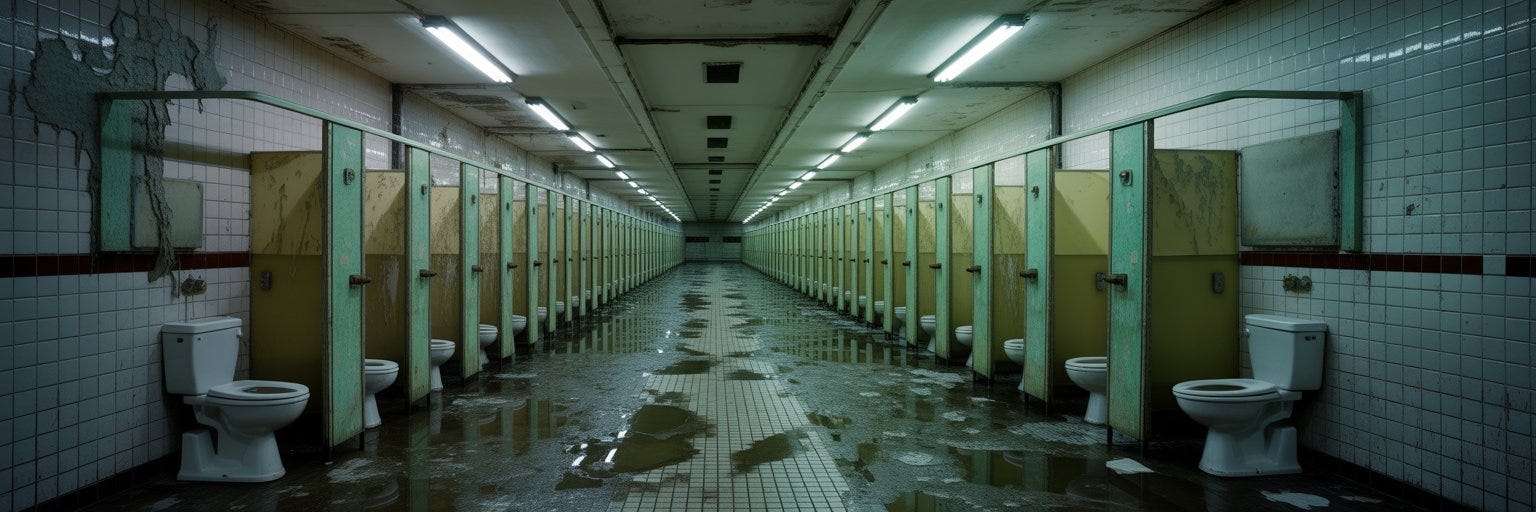
1. The Infinite, Filthy Toilets Forget finding a clean restroom. A hallmark of Mall World is a sprawling, maze-like bathroom where nothing works. The stalls lack doors or privacy, the toilets are often overflowing or arranged in open rows, and the entire area is covered in grime.
2. Physics-Defying Elevators Getting around is a terrifying ordeal. Mall World elevators are notoriously untrustworthy—they plummet suddenly, shoot upward at breakneck speeds, move horizontally, or sway wildly without walls. In some cases, riders even have to solve complex math equations or enter formulas just to select the right floor.
3. The Dark Descent of the Lower Levels The upper floors of the mall might resemble a bustling, brightly lit shopping center, but taking the escalator down reveals a different reality. The sub-basements and lower levels become progressively darker, taking on an eerie, industrial, and highly unwelcoming bunker-like atmosphere.
4. The Sudden Airport Transition You are walking past a Banana Republic one second, and suddenly you are standing in a TSA security line or a dimly lit airport terminal. The mall seamlessly morphs into massive transportation hubs—including sprawling, multi-platform subway stations with empty trains—where you can never seem to find your actual departure gate.
5. The Impossible Parking Lot If you try to leave, you will likely end up in a massive, endless concrete parking structure. Dreamers consistently report the same frustrating loop: wandering for hours through a spiraling, gigantic lot, entirely unable to locate where they parked their car.
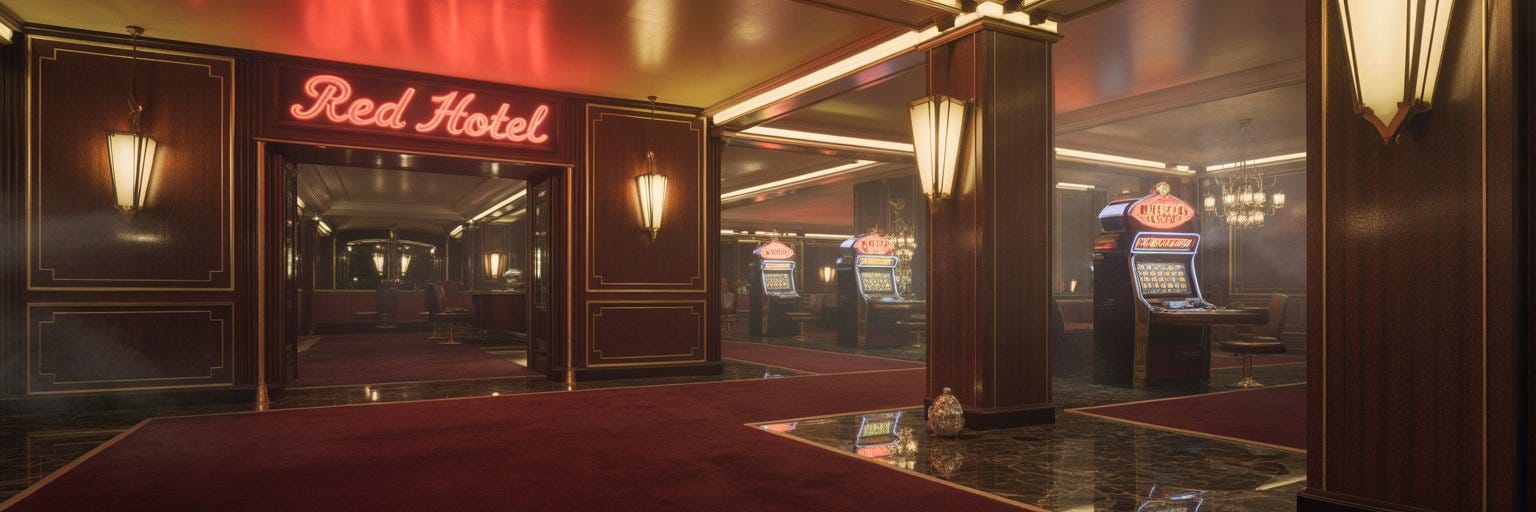
6. The “Red Hotel” and Casino Many wanderers eventually find themselves checking into an opulent but eerie attached resort. This wing is frequently described as having 1930s-1950s era decor, dark wood-paneled corridors, gold finishings, and plush red velvet carpets, often accompanied by a smoky casino or an old-timey bar.
7. “Staff Only” Backrooms Those who accidentally (or purposefully) wander behind the storefronts find themselves in dimly lit, labyrinthine service corridors and cubicles. This discovery is almost always met with a sudden, chilling voice from a shadowy figure declaring, “You aren’t supposed to be here”.
8. Adjoining Schools and Campuses Mall World isn’t purely retail. Corridors frequently spit dreamers out into university campuses, libraries, or multi-story school dormitories. Dreamers often find themselves wandering these academic halls, stressing over lost schedules or forgotten classes.
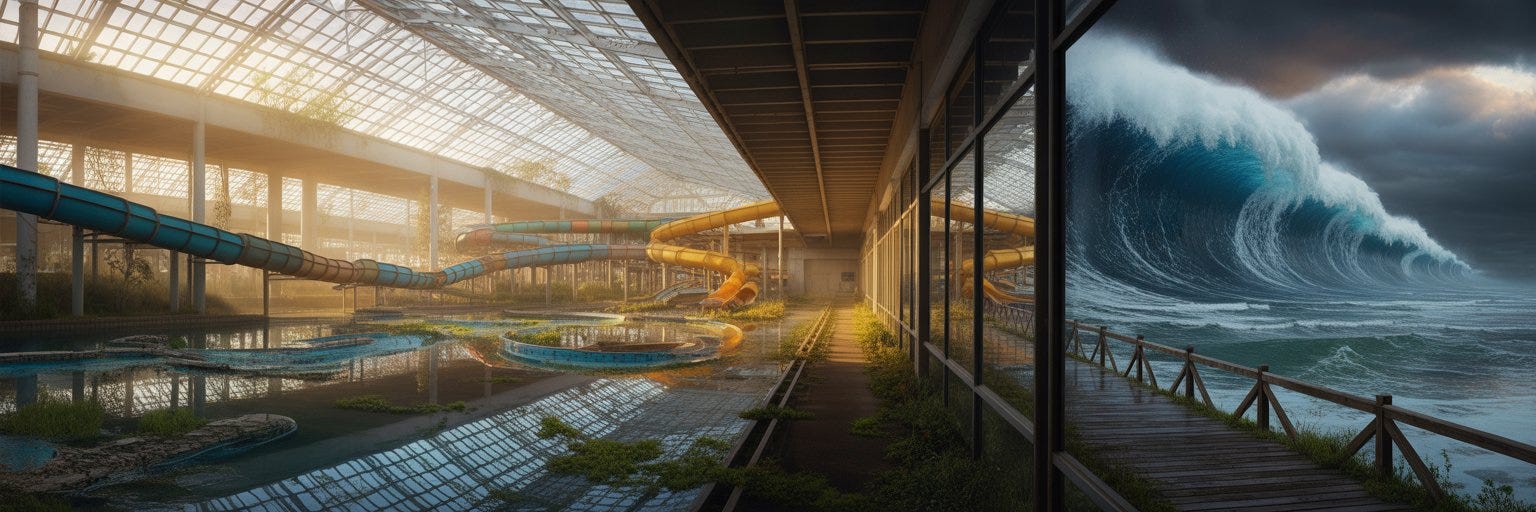
9. Abandoned Waterparks and Looming Tsunamis At the edges of the mall, dreamers regularly stumble upon abandoned indoor water parks or coastal boardwalks trapped in a permanent golden-hour twilight. For many, stepping out onto this beach triggers a terrifying, recurring event: a massive, apocalyptic tsunami wave building on the horizon.
10. The Uncanny Security Guards The mall is patrolled. Dreamers frequently report being watched, chased, or confronted by “security guards”. These entities range from friendly but eerie watchmen playing hide-and-seek to hostile, heavily armed, or mannequin-like figures patrolling the hidden tunnels and upper balconies.
WHY MALLWORLD MIGHT BE REAL
If you are looking for physical coordinates on a map, Mallworld doesn’t exist. But if you define “real” as a demonstrable, shared experience that actively impacts human consciousness, Mallworld is incredibly real.
The phenomenon sits at the intersection of neuroscience, sociology, and esoteric philosophy. Here is why the shared dreamscape of Mallworld is more than just a random coincidence:
1. We Share the Same “Cultural Architecture” The most grounded reason Mallworld exists is that millions of people grew up absorbing the exact same spatial templates. American malls in the 1980s, 1990s, and 2000s were built using remarkably similar designs: anchor stores on the ends, a central food court, and escalators as centerpieces. When our sleeping brains reach for raw material to construct a dream environment, they pull from these deeply encoded, shared spatial memories. Anthropologist Marc Augé famously defined modern malls and airports as “non-places”—transient, uniform zones built for efficiency and consumption rather than human connection. Because these environments are stripped of personal identity, they serve as the perfect blank canvases for our subconscious minds to project anxieties about modern life.
2. It is an Active “Social Contagion” Mallworld is real in the sense that it is actively spreading. Dr. Dylan Selterman, a dream researcher at Johns Hopkins University, points out that there is no scientific evidence for telepathy, but there is strong evidence for social contagion. When you encounter the concept of Mallworld online—reading descriptions of infinite bathrooms or labyrinthine corridors—the idea is planted into your waking discourse. This dramatically increases the likelihood that your brain will incorporate these specific architectural features into your next dream, effectively making the shared dream a self-fulfilling prophecy.
3. It is a Modern Manifestation of the “Collective Unconscious” Psychoanalyst Carl Jung theorized that all human beings share a collective unconscious—a foundational psychic network containing universal, inherited symbols known as archetypes. Under this psychological framework, Mallworld is a highly real, shared symbolic field. Just as ancient humans dreamt of temples, labyrinths, and bazaars to process their reality, modern humans dream of the shopping mall. The recurring features are deeply archetypal: endless escalators represent ascents and descents in consciousness, looping exits mirror feelings of being trapped, and abandoned upper floors symbolize neglected potential.
4. It Triggers a Genuine “Uncanny Valley” Neurological Response The profound sense of dread and eeriness people feel in Mallworld isn’t imaginary; it is a documented cognitive response. Scientific studies have demonstrated that there is an “uncanny valley” of physical places. When built environments contain structural deviations—like missing windows, distorted proportions, or impossible repetitions (such as an endless row of toilets)—our brains struggle to categorize the space. This inability to process the environment triggers genuine, measurable feelings of ambiguity and biological threat.
5. The “Egregore” and the Mundus Imaginalis In fringe and esoteric communities, Mallworld is considered real on a metaphysical level. Some theories propose that it is an “egregore”—a psychic entity or energy structure that has literally been brought into existence by the collective belief, attention, and emotional focus of thousands of people talking about it online. Others view the phenomenon through the lens of Henry Corbin’s Mundus Imaginalis (the imaginal world). This theory posits an objective, intermediary realm between the physical world and the spiritual world where archetypes take on symbolic, spatial forms. In this view, Mallworld isn’t just a dream; it is an actual destination within a shared, multidimensional landscape.